By Aashu, owner of Stitch Partner, Nagpur, India. We supply industrial sewing machine spare parts to garment units across the country.
Multi-needle machines such as the Kansai Special DFB series run long shifts on elastic, waistbands and knit fabric, so their small parts wear in a predictable order. If you know that order, you can keep the right spares on the shelf and stop a line from waiting on a part. This guide covers the parts we are asked for most.
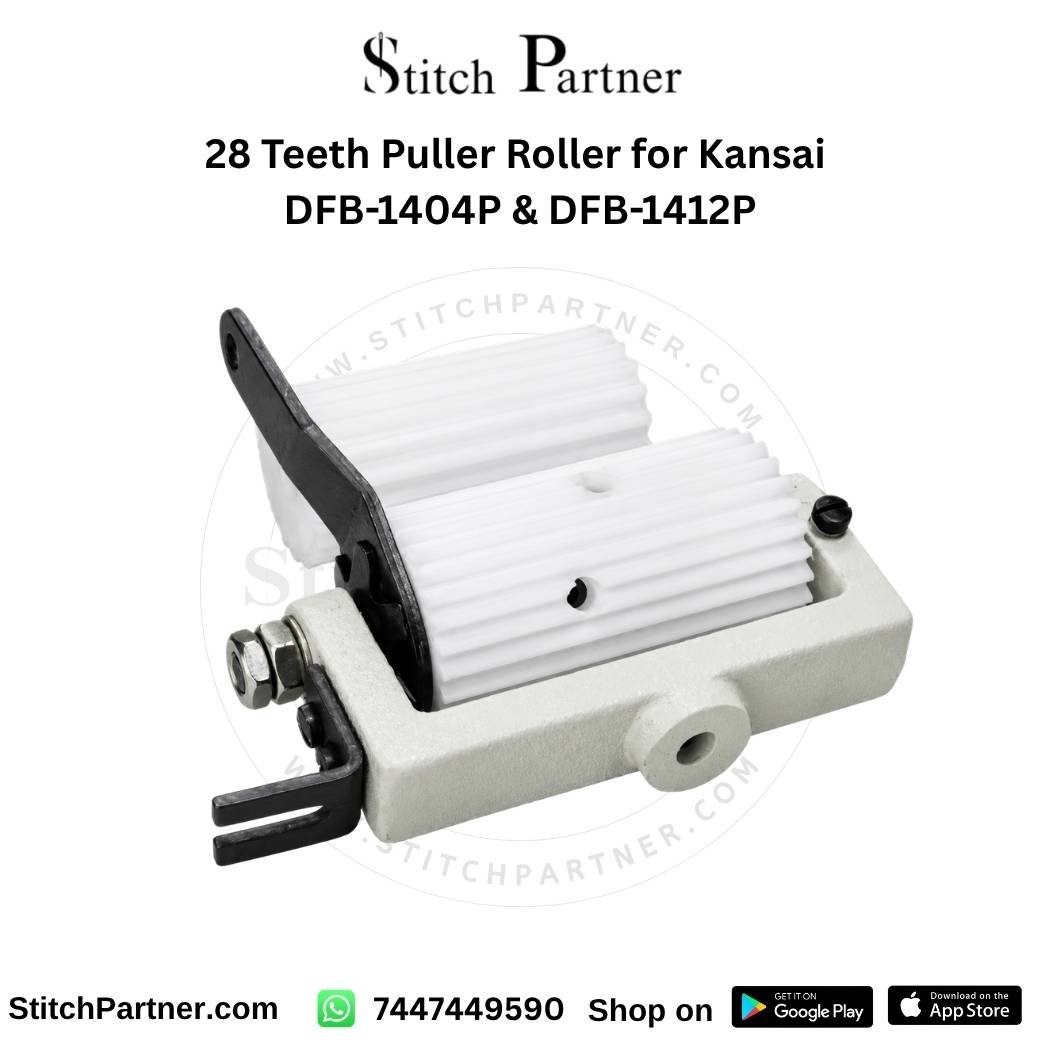
The puller roller grips the fabric as it leaves the needles. Once the teeth wear smooth, the seam starts to pucker or the fabric slips. Rollers are specific to the machine model, so match the tooth count and model before ordering. Our 28 teeth puller roller for Kansai DFB-1404P and DFB-1412P is one example. Machines from other brands use different rollers, such as the 12 needle puller roller for Siruba VC008 and Jack JK-8009.
Oil leaks usually come from a hardened gasket, not from a cracked casting. Replace the gasket before you replace anything larger. We stock several Kansai gaskets, including 23-137, 23-157, 23-206 and 23-229. Read the number printed in your parts book, since the numbers look alike.
When stitches skip on the underside, check the looper before you touch the timing. A loose looper screw or a worn looper holder lets the looper drift out of position. Tighten and re-check the looper-to-needle clearance first. Then replace worn parts rather than repeatedly re-timing.
Uneven tension across needles often comes from a worn tension post or a chipped guide. A 40-144 tension post set restores a smooth thread path. For the needles themselves, the 45-157 12-hole needle thread guide keeps each thread separate, and the 69-120 needle bar guide plate keeps the needle bar aligned.
Play in linkages shows up as noise and timing drift. Common replacements are the 61-711 connecting ball rod, the 65-334 puller connecting bar and the 02-101 three stars. Elastic feeding is handled by the 45-430 elastic guide for 1404 and the metering device.
Browse the full range at stitchpartner.com. Delivery across India, with cash on delivery available.
| Symptom | Check first |
|---|---|
| Seam puckers or stretches unevenly | Puller roller wear and pressure |
| One needle thread keeps breaking | Bent needle, sharp edge in that thread path, tension post |
| Skipped stitches on one needle only | That needle, then looper position |
| Oil on the fabric or table | Gaskets and seals |
Related: Yamato overlock and flatlock parts guide and the parts book guide for finding part numbers.
Check the nameplate on the machine arm or bed for the model name and number, and compare it with the parts book. Send a photo of the nameplate and the worn part if you are unsure.
Needles, puller rollers, gaskets and seals, and small looper parts are the usual wear parts. Keeping a few reduces downtime.
Usually that needle is bent or blunt, or its thread path has a sharp or rough spot. Replace the needle and inspect the thread guides before changing tension.